
Workout of the Day: 3 x (10 x 400m)
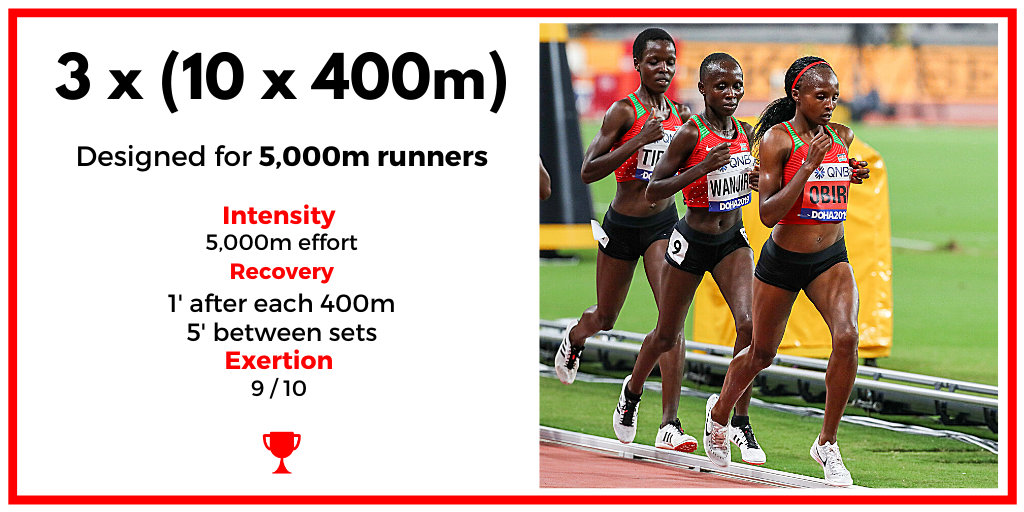
3 x (10 x 400m)
Intensity — 5,000m effort
Recovery — 1 minute after 400m reps, 5 minutes between sets
Exertion — 9/10
Context & Details
Often, when we don’t think something is doable, we tend to ridicule and make fun of it. When Daniel Komen shattered the 3,000m world record in 1996 by clocking 7:20, the announcers were making fun of him and laughing at the pace he was running in the early stages. They eventually changed their tune to astonishment by the end. You can watch that record run here.
It’s an amazing performance. And the commentators’ narrative offers an equally interesting lesson in psychology and our resistance to believe amazing even when it is happening right in front of us. It’s kind of like how doctors in the 1940s and 1950s said breaking 4:00 for the mile will cause a man’s heart to explode. Bannister did not die after his record run — in fact, he enjoyed 89 years of life.
One of my goals with WOTDs is to expose the reader to legitimate workouts, done by world-class runners, which preceded a series or season of high performances. This is one of those workouts.
The workout was done by Hicham el Guerrouji in his build-up to double gold in the 1500m and 5,000m in the 2004 Athens Olympic games. If you don’t think this is possible, by all means, hop in a time machine and tell El G he can’t do what he did.
In order to grow in coaching, I think it’s important to keep an open mind as well as try to understand and unpack why something works and what it does to stimulate upgrades in performance ability.
I’ve noticed one of the primary differences between American and African runners and coaches is the focus on upgrading resistance to fatigue.
Renato Canova said, “A Kenyan runner’s mentality is to run at the right speed. The Western runner’s mentality is to run the right distance.” In America, we have a “Completion-of-Assignment Bias” in running. I think it stems from our running coaches and athletes being products of the scholastic system. In school, compliance and completion is prized. Exploration and effort, if it results in an incomplete, are to be avoided — incomplete assignments in America are the mark of a failure.
In Africa, the goal is to get better. This is done by a sharp focus on running the right speed for as long you can, then working to extend that ability. Initially, you can only go 400m at your goal 5,000m pace. That’s OK. That’s what’s training is designed for: to practice extending your ability to compete at your desired race speeds.
Kenyans regularly drop out of workouts in training if they start to “blow up” and are unconcerned by it. Tomorrow is a new day.
Americans tend to be modified and obsessive if they don’t complete a workout. All is lost for the season if a single workout is not completed. What happens in today’s workout determines the rest of the season.
In America, we tend to focus on running enough distance first, then trying to run some of those miles faster later. International running results over the past 30 years are clear on what method is best — in fact it is not even close — the Africans win by a landslide.
This session is a fully mature workout for a runner, like El G, who has systematically upgraded their resistance to fatigue over a season and career.
What is resistance to fatigue? It’s the ability to sustain a high-quality velocity (like race pace) for an extended period of time without a falloff in pace or intensity.
Science has not yet determined what factors determine a runner’s resistance to fatigue just yet. Some theories focus on glycogen concentrations, heat dissipation ability, elastic or stretch reflex function, or mechanisms related to the central (neural) governing theory.
Modern African runners and coaches understand the value and focus on cultivating a high resistance to fatigue capacity. It is one reason why Kenyans are recorded as competing at a higher vVO2 Max than Americans. Their ability to sustain so-called “Red Lining” speeds is better trained.
But the funny thing is this is nothing new.
Lydaird’s base phase was running systematically aimed to elevate a runner’s “condition” aka residence to fatigue. If you look at his schedules, 10-mile base runs at 1/4 effort are thought to be at about 5:20 - 5:10 pace — and that is an “easy” base run. Runs at 3/4 effort are around 4:45/mile speeds for 10 - 16 miles. When you study the history of running like Steve Magness and I have, you’ll find that Ron Clarke, Prefontaine, Jim Ryun, Frank Shorter, Salazar, Coe, Steve Jones, etc. all understood the resistance to fatigue ability to be central to the condition of their performance ability. So Americans got it, and then we forgot it somewhere in the last 25 years.
Jerry Schumacher and his runners are perhaps the poster children for the resurgence of a clear focus on resistance to fatigue training. There is no high volume easy jogging in his program. It’s mostly long, semi-fast or moderate miles. The Bowerman TC fall/winter base phase and “Jerry Miles” are basically a steady diet of steady aerobic runs totaling 100 - 150 actual miles per week. When Webb trained with Jerry he ran 140 real miles per week in the fall. The BTC pros runners will call these miles “slow” but the majority of them ran are under 5:40 pace (for men).
Think about it: 12 - 16 weeks of 100 -150 miles at sub-5:40 mile pace — that will get you fit, or as Jerry likes to say, it will “get you in shape to get in shape.”
OK, that was a long tangent. Let’s circle back to today’s workout.
In addition to upgrading resistance to fatigue at the desired race pace, this session also elevated vVO2 Max, running economy (which is the oxygen cost of running at a specific speed), and race-specific lactate-threshold velocity.
You, or the runners you coach, might not be ready for this exact workout as written. But you can scale down the session to fit your needs. Instead of 400s, do 200s. Instead of 3 sets of 10, do 3 sets of 5. What matters is understanding why the session works and how to use the principles to apply a similar session, if desired, to your level.