
Workout of the Day: 6 x 2,000m
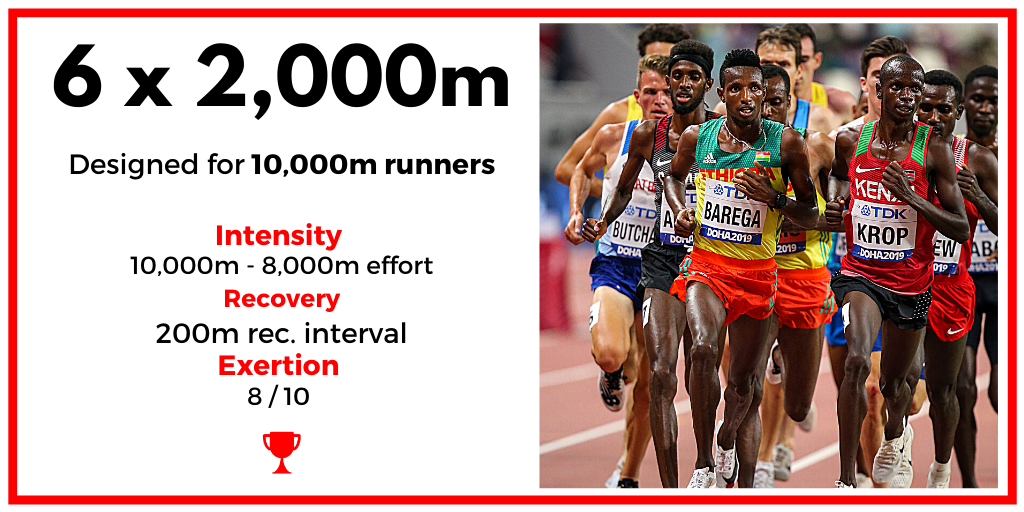
6 x 2,000m
Intensity — 10,000m - 8,000m effort
Recovery — 200m rec. interval
Exertion — 8/10
Context & Details
When training the body, you need a stimulus to drive change. No stimulus = No change. I realize this is physiology 101, but revisiting fundamental principles regularly can be helpful. In this case of this workout, eliciting a stimulus can happen a few different ways.
First, the duration of the repetition, the 2,000m distance itself can be a stimulus. Second, the speed of the repetition is another stimulus. Third, the quantity of 2K repeats, in this case six. And finally, the density — or time of the recovery intervals between repetitions is another stimulus.
The sexy thing to do is chase impressive numbers in workouts like fast times for the repetitions or a high volume of reps. However, these don’t upgrade fitness as much as advancing the duration and density of the reps.
A bigger stimulus is had by running longer without interruption or taking shorter periods of rest.
Meaning, 6 x 2,000m at 5:55 per 2K (4:45/mile speed) on 45” recoveries over 200m is a more stimulating workout than 6 x 2,000m at 5:35 (4:40/mile speed) on 3’ recovery intervals. The former workout is less sexy, but far more effective.
Remember, there are no timeouts on race day. Therefore, your practice of race pace should progress to include a hearty dose of long repetitions with little to no rest.
I sometimes joke with some of my college coaching friends who will update me on a workout their athletes did by replying, “nice workout, but too much rest on the recovery intervals!” It’s all in good fun, but there is a hint of truth in my ribbing.
Interval training was originally designed with a focus on improving the recovery intervals. Many coaches and runners today think “interval” is the faster running segment of a workout. Not so. Those faster segments are called repetitions. The interval is the recovery period taken between the faster segments, or repetitions.
For endurance (both short and long) running, performance is closely correlated with how little fatigue accumulates when running for sustained blocks of time at a desired pace. To upgrade this ability, the focus should be advancing the duration/volume one can run a pace with little to no recovery required between these efforts — both on a micro (recovery intervals in a specific workout) and macro (between workouts within a training week).
The less recovery you need to repeat exposure to race pace, the fitter you are getting.
So where do you start? I, like Canova, start with intensity and then seek to extend an athlete’s “strength-endurance” or stamina by systematically shortening the recovery periods as training progresses.
Take the example of imaginary runner who wants to run 29:30 for 10,000m. At the start of the season, the first running of this workout might be 4-5 x 2,000m at 5:55 with as much recovery as is needed to sustain 5:55 throughout the session. Next time we might progress to 6 x 2,000m at 5:55 with no limitations on the duration of the recovery intervals. The first goal is to introduce and stabilize the stimulus of running 5:55 for six blocks of 2,000m. As the runner revisits the workout throughout the season, progress is not measured by a quickening of the 2,000m intervals, but by shortening the recovery intervals. With repetition speed stabilized, upgrades in fitness are measured by how little rest is needed to sustain six repeat 2K work-bouts at 5:55.
Ideally, we’d revisit this session every 10-14 days and see the 200m recovery interval improve to only 45” before the target 10,000m race. This process could take as little as eight weeks or as much as 16+ weeks, depending on the runner’s background.
These concepts and principles presented apply to stamina workouts of any speed or length for any runner (800m and up) and are the backbone of effective interval training.
To recap: First, establish the desired race pace. Then progress to the desired repetition duration. And finally, this where most of the stimulus will be realized, focus on shortening the recovery intervals to as short as possible without compromising the speed of the repetitions.