
Workout of the Day: 4 x 2 Miles
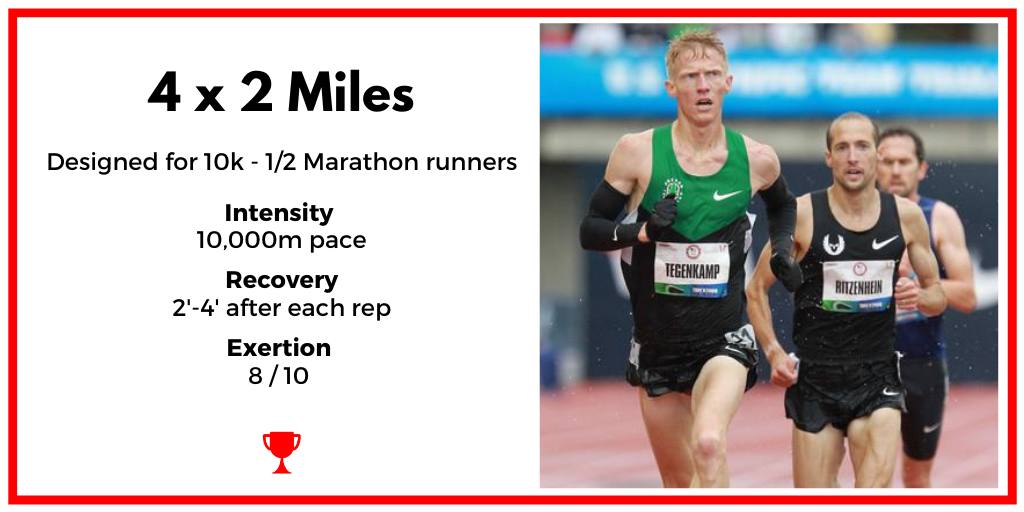
4 x 2 Miles
Intensity — 10,000m pace
Recovery — 2-4 minutes walk/jog after each rep
Exertion — 8/10
Context & Details
Resistance to fatigue is the ability to sustain a high-quality velocity for an extended time without a fall off in pace or intensity. It’s an important predictor of performance.
Runners often become fatigued before reaching maximal rates of oxygen consumption, topmost heart rates, or highest levels of blood lactate. Fatigue, then, cannot be neatly explained by oxygen or cardiac limitation or excess lactate accumulation in the blood. Which, when you think about, is pretty interesting.
Tim Noakes, has popularized the Central Governing Theory to account for this. In essence, the Central Governing Theory puts forth the idea there are neural-output limits in a runner’s brain that do not permit specific intensities, or speeds, of running to be continued beyond fixed duration.
This workout directly aims to enhance this neural limitation.
Extended periods of training at a specific running velocity hikes the resistance to fatigue at that specific speed. Additionally, 10K pace work is technically speed work. Albeit the lowest velocity of speed work available. It is important to note, I define “speed work” for distance runners as any running carried out at faster than lactate threshold steady state velocity but not faster than 800m speeds — this correlates to roughly 10,000m to 800m race pace work. Maximal speed training is different that speed training, is defined as velocities faster than 800m race pace.
With this understanding, extended periods of 10K pace work (as presented in this session) offer the short endurance runner (5,000m - 1/2 Marathon) upgrades in lactate threshold, running economy, and vVO2 Max, in addition to fatigue resistance abilities.
The runner will also derive a high degree of confidence in their abilities from performing 8 miles at their 10K pace. Optimal methods of progressing the session will seek to first shorten the recovery periods, then increase the velocity of the repetitions, and finally extend the repetition distance with an upper limit being 2 x 4 Miles.
Any questions? Send me a Direct Message on Twitter.
Thx. | jm