
Workout of the Day: 3 x (1M + 4 x 400m)
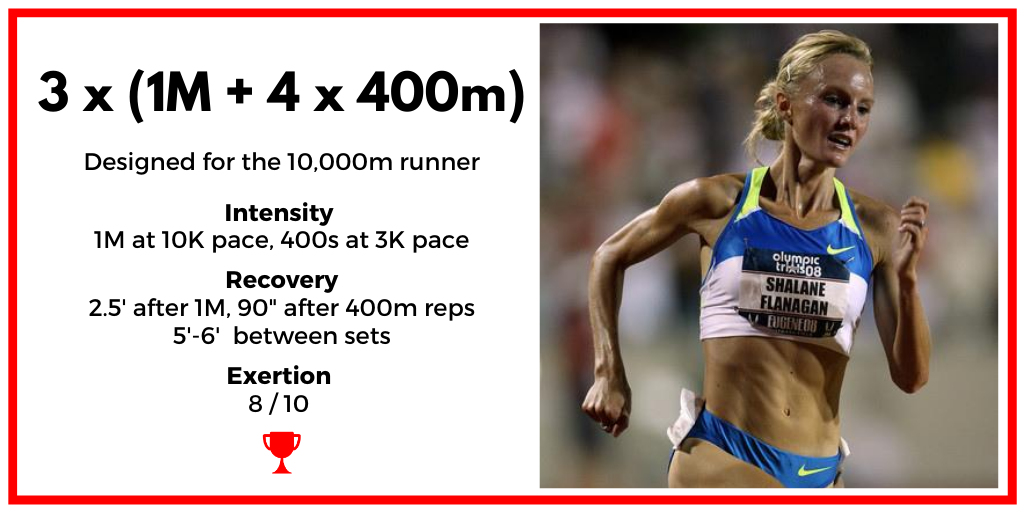
3 x (1M + 4 x 400m)
Intensity — 1M at 10K pace, 400s at 3K pace
Recovery — 2.5 minutes walk/jog after 1M reps, 90 seconds walk/jog after 400m reps, 5-6 minutes walk/jog between sets
Exertion — 8/10
Context & Details
I first saw this workout in Brad Hudson’s “Little Black Book” of workouts. It’s brilliant. This is a highly effective session for the what I call the “short-endurance” runner (5,000m - 10,000m runner).
This workout advances several performance variables, but I am going to focus on how it upgrades a runner’s Lactate Threshold.
Scientific research is revealing that fairly intense training, not high volume work at moderate intensity, is the best booster of velocity at lactate threshold. More evidence is indicating moderately paced training is not very specific to racing for 10,000m and shorter. One goal of effective lactate threshold training is to expand the the abilities of the heart to clear lactate from the blood. Remember, lactate is high octane fuel which helps the muscles, heart, and other cells meet immediate energy demands. However, there is a tipping point (lactate threshold) for each runner when too much lactate is present in the tissues and cannot be consumed in a timely manner. The excess lactate spills over into the bloodstream and becomes a corrosive agent, what is commonly referred to as “Lactic Acid.”
This is not the time or place to go over the long list of popular myths associated with Lactic Acid. For now, let’s agree to respect the reality that the majority of common knowledge about Lactic Acid is wrong.
OK, back on topic.
Effective lactate threshold accomplishes 3 key variables:
Enhancing muscle tissue use of lactate and pyruvate as fuel
Increasing aerobic enzyme production
Increasing the amount of MCT1 (monocarboxylate transporter 1), a muscle protein which transports lactate directly into muscles cells where it can be metabolized for energy.
This workout creates an internal environment which advances those 3 variables. One of the most potent stimulus for advancing these variables is training with high blood and muscle lactate levels. This runs opposite to traditional ideas about Lactate Threshold being optimized just below running velocity where lactate begins to accumulate in the blood. However, carrying out training at manageable lactate levels will not stimulate muscles to begin increasing production of MCT1.
What coaches call “pushing the envelope” is wise practice for short, manageable, just-outside-the-comfort-zone periods, as practiced in this session. Following a 1 Mile at 10K pace with 4 x 400m at 3K velocity on shallow recovery results in a significant increase in the body’s lactate production going into the 3rd and 4th 400m rep of each set. This creates an environment where the athlete calls on a high energy demand to run the final 400m reps at a fast velocity with increasing high blood lactate levels. The physiological training effect is a promotion of higher levels of MCT1, aerobic enzymes, and better use of lactate and pyruvate as fuel by muscle tissue.
Finally, don’t forget the “toughness” teaching opportunity associated with this session. The coach can use the challenging situation this workout’s construction creates by encouraging the athlete to enhance their self-concept as a “tough” runner, or “clutch” performer, who steps up and delivers their best effort in difficult situations. This approach will afford a significant psychological upgrade to the athlete.
Mentally, most competitive runners are capable of “willing” themselves to running two 400s at 3K pace in a rapidly fatiguing state. And by doing so they’re elevating not just their self-concept, but their lactate threshold as well.