
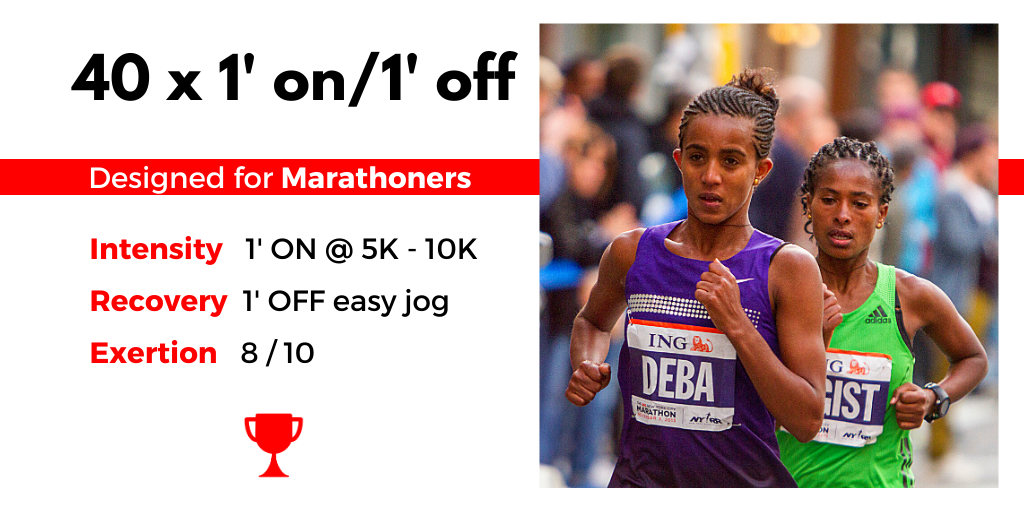
40 x 1' ON / 1' OFF
40 x 1’ ON / 1’ OFF
Designed for Marathon runners
Intensity
1 minute “ON” at date 5K - 10K effort
Recovery
1 minute “OFF” easy jogging
Exertion
8/10
Periodization
General Period, Introduction Block
Context & Details
Fartlek work is perhaps one of the best early-season workout options because it promotes running by feel. When the time comes to formalize paces later in training the runner familiar with fartlek training will be better acclimated to the sensations and effort associated with different running paces.
Classic fartlek training is organic and unstructured. It is based on the feel and inspiration of the runner in the moment.
Today’s session is a “Structured Fartlek” where the speed play bouts and recovery segments are determined beforehand.
Fartlek runs challenge the body to adapt and sustain various speeds, conditioning runners to become faster over longer distances. Fartlek training accomplishes this with its emphasis on continuous running. Overall average heart rate (HR) will typically be higher for a fartlek workout than slow-paced long runs or moderately-paced tempo runs as the jogging segments do not allow HR to drop all that low during the recovery portions.
Finally, runners of all fitness levels tend to benefit substantially from fartlek training as it releases them from the burden to “make time” by feeling obligated to hit a certain split. It also allows them to do more work since they don’t have pace as a measure to judge the quality of rep or the entirety of a workout. With fartleks, the goal is simply to “run hard.” The subjectivity environment fartleks create allows for less concern on the runner’s part since they only need to focus their attention on their effort level. The creates the condition for runners to run more fartlek reps and get in more quality work in a session.
Today’s session is geared towards experienced marathoners in the General Period.
This session is alternated weekly with a more traditional longer steady run during that period. The design of this workout boosts several key performance variables, including lactate-threshold velocity, fatigue resistance, running economy, and neuromuscular power and coordination.
You might look at the session and think “there’s no way anyway could do 40 one-minute segments at 5K - 10K pace on 60 seconds recovery.”
However, as described before, with fartleks pace doesn’t really matter, effort is what counts.
In the final third of the workout the pace of the one-minute “on” segments might record at 15K or Half Marathon speeds, but the effort will feel like 5K or 10K. This will result in a physical and mental callousing which will serve the runner well in later periods of training and on race day.
I like marathoners to perform this session 3 - 4 times during the General Period and early on in the Foundational Period of training.
For less experienced marathoners you can customize the session by adjusting either the volume of reps, the duration of recovery, and/or the desired intensity of effort.
Continue Learning
Join the Scholar Program for $29 to learn more about successful Marathon Training and get unlimited access to courses and training programs on long-distance running.
Good books on Marathon training
Advanced Marathoning by Pete Pfitzinger
Run Faster from the 5K to the Marathon by Brad Hudson
Running Rewired: Reinvent Your Run for Stability, Strength, and Speed by Jay Dicharry
Hansons Marathon Method: Run Your Fastest Marathon the Hansons Way by Luke Humphrey