
Workout of the Day: 8 x 300m
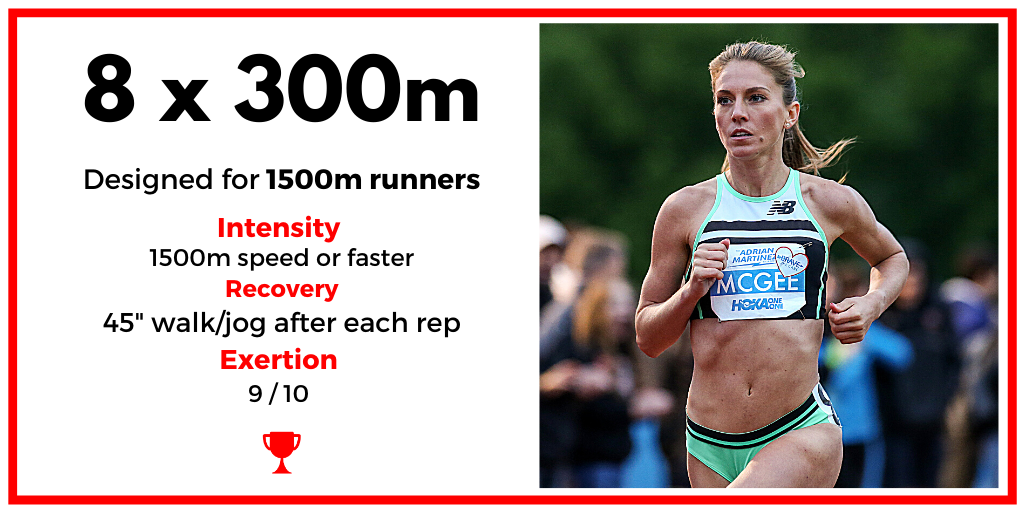
8 x 300m
Intensity — 1500m pace or faster
Recovery — 45” walk/jog after each rep
Exertion — 9/10
Context & Details
This was Seb Coe’s acid test workout.
When he was in peak form he would rip the 300m at 38”-34” on 45” recoveries. Yes, you read that correct.
I understand 2019 World Champion in the 1500m Timothy Cheruiyot does a similar session in training as well — although I was asked not to go into details.
To quote Peter Coe, Seb’s father and coach, “The runner who buffers best will beat the rest.” He is referring to lactate buffering or clearing rates.
So much of competitive running success has to do with the efficacy of a runner’s lactate-threshold velocity. It is not the sole determinate, by any means. But it has a heavy influence. Here’s why:
Lactate is a fuel produced by muscle cells all the time and is often the preferred source of energy in the body: The brain and heart both run more efficiently and more strongly when fueled by lactate than by glucose, another fuel that circulates through the blood.
It was thought that lactate is made in muscles when there is not enough oxygen. It has been thought to be a fatigue agent, a metabolic waste product, a metabolic poison. But the classic mistake was to note that when a cell was under stress, there was a lot of lactate, then blame it on lactate. The proper interpretation is that lactate production is a strain response, it's there to compensate for metabolic stress. It is the way cells push back on deficits in metabolism.
Glucose and glycogen are metabolized through a complex series of steps that culminate in lactate. Conditioning in sports is all about getting the body to produce a larger mitochondrial reticulum in cells to use the lactate and thus perform better.
Remember, significant improvements in lactate-threshold velocity are made at race-specific speeds. This is why this session, and not 4 mile continuous tempo runs, is superior to upgrading this critical physiological race day performance variable in 1500m runners.